How many birthday party bookings are you losing to slow reply times?
Most party inquiries arrive after you have closed for the night. What happens between then and your first reply is where the bookings disappear.

Alice Rizzi Franssens
Marketing

A parent decides on a Tuesday night that this is the year for the big party. The kids are finally asleep, they open a laptop, and they send more or less the same message to three venues. Yours is one of them.
It is 9:40pm. You closed at eight. The message sits in an inbox until someone opens it the next morning, reads it somewhere between a delivery and a party setup, and replies after lunch. By then the parent has already heard back from another venue, booked a call, and half made up their mind.
None of that is anyone's fault. It is what happens when an inquiry lands outside the hours a person is there to answer it. And it happens far more often than most operators think, because the moment a parent is finally free to plan a party is almost never the moment your team is free to respond.
The reply window is shorter than it feels
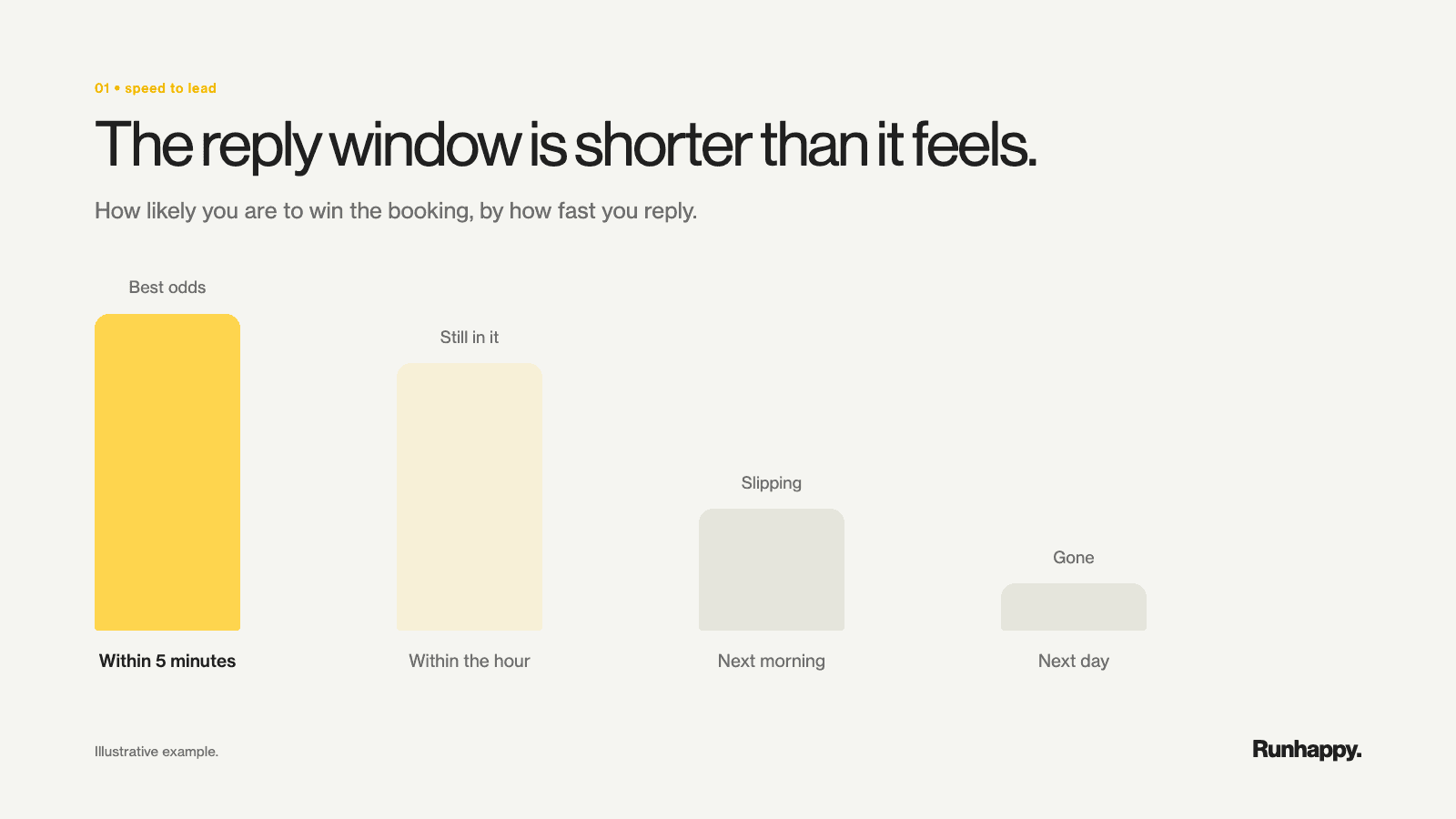
The instinct is that a party booked for six weeks out can wait a few hours for a reply. What buyers actually do says otherwise, and it is not close.
Harvard Business Review's study of online sales leads found that companies which reached a new lead within an hour were nearly seven times more likely to have a real conversation with a decision maker than those that waited just an hour longer, and more than sixty times more likely than those that waited a day (The Short Life of Online Sales Leads). The lead did not stop caring. It just got answered by someone else first.
A birthday inquiry behaves the same way. The parent who fired off three messages at once is sitting there comparing the replies, and the venue that answers first, with something useful, sets the terms for everyone who answers after. Speed here is not about seeming eager. It is about being the one still in the conversation when the decision actually gets made.
The lost bookings cluster after hours
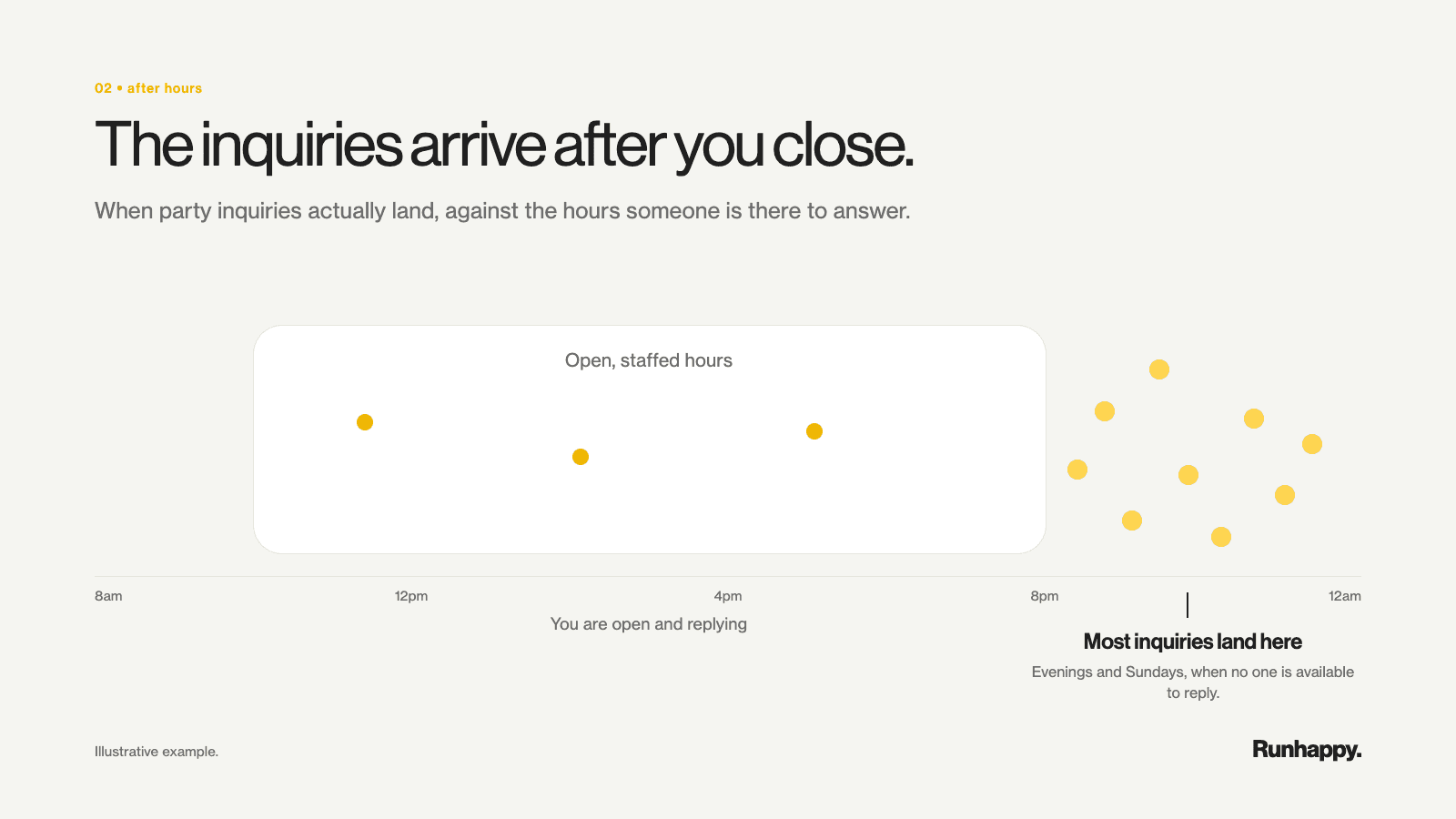
Look at when party inquiries land and a pattern shows up fast. Evenings. Sundays. The hour after bedtime. Operators describe it almost word for word across venue types: parents are not calling between nine and five, they are doing this once the kids are down and the building is already dark.
That is the gap. Not slow people, a closed venue. The inquiries that arrive during staffed hours usually get handled fine. The ones that arrive at 9pm on a Sunday sit until morning, and sitting until morning is precisely what the research says you cannot afford.
Put rough numbers on it and it stops being abstract. Say a venue takes forty party inquiries a month and a third of them land after hours. That is around thirteen a month waiting overnight for a first reply. If even a quarter of those book elsewhere while they wait, that is three parties a month. At four to five hundred dollars each, before add-ons, you are losing it through a door nobody is minding. Over a year that is the cost of a part time hire, gone to reply time alone, and it never appears on a report because a booking that was never confirmed leaves no trace.
Want to see what that number looks like for your own venue? Book a demo and we will go through your inquiry times with you.
A booking button is not a faster reply
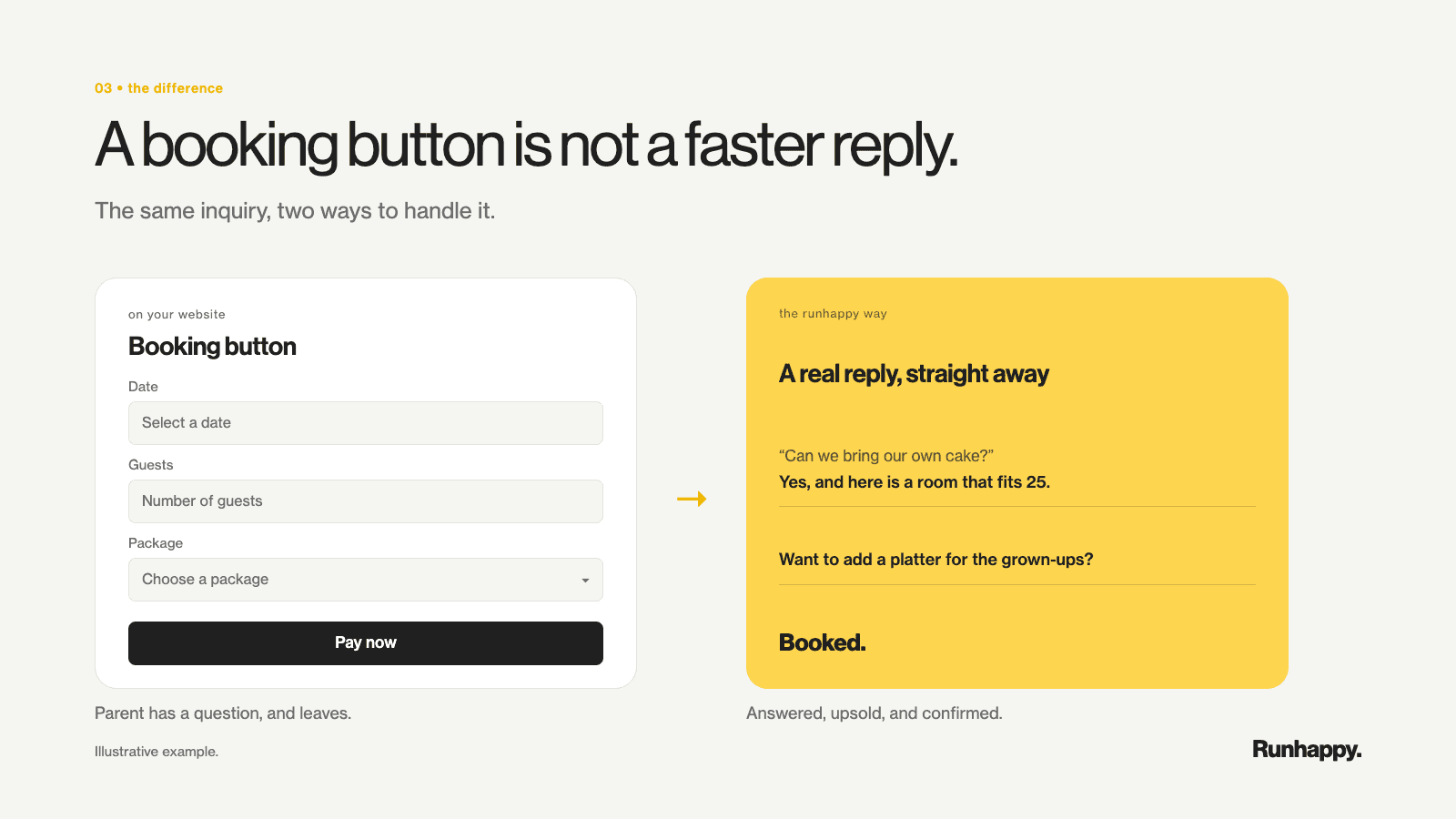
The obvious fix looks like self service. Put a booking button on the site, let parents check out on their own, and the after hours problem takes care of itself.
It rarely works, and the operators who have tried it say so plainly. One multi-location operator called their direct booking tool a total failure, with parents finding ways around it to reach a person anyway. A family about to spend two thousand dollars on their child's party does not want a checkout page at 9pm. They want a question answered. Can we bring our own cake. Do you have a room that fits twenty five. Is the toddler area included, and can the adults get real food while they wait.
A booking link answers none of that, so the inquiry becomes a message, and the message waits. Self service moves the delay around, it does not remove it. The friction was never the form. It was the wait for a human reply, and a link does not shorten that.
What a genuinely fast reply takes
Answering quickly, every time, across every channel a parent might use, is harder than it sounds, which is why so few venues manage it consistently.
The inquiry could come through the website, a text, Instagram, Facebook, or a Google listing. It could be one simple question or the start of a fifteen message back and forth about timings, allergies, and whether the older cousins count toward the guest total. Covering all of that, at 9pm and again at 9am, without pulling someone off the floor in the middle of a shift, is not a scheduling problem you can roster your way out of. It is a structural one, and structural problems do not respond to trying harder.
This is the same gap that quietly caps a venue's event revenue long before the calendar is full. The parties are good. The prices are fine. The replies are late.
How Runhappy keeps birthday party replies instant
We run the booking side of your venue so the reply goes out the moment an inquiry lands, whatever the hour. A parent who messages at 9:40pm gets a real answer, not an auto responder promising that someone will be in touch. The common questions get handled straight away, the booking gets guided all the way to confirmed, and the genuinely unusual ones still reach a person on your team.
It works across the channels parents actually use: the website, text, social, and search. And it connects to the booking flow and event pages and the systems you already run, so a confirmed party lands where your team expects it, ready to set up. Nobody on your side logs into anything.
None of this replaces your team. It gives them their evenings and weekends back, the ones they used to spend half watching an inbox. It makes sure the package and add-on choices you built are actually offered in the moment a parent is deciding, not forgotten at a busy check in desk.
The throughline
Most venues do not lose these bookings because their parties are worse or their prices are off. They lose them in the quiet hours, to a reply that arrived too late to count. The venue that answers first, clearly, and at the moment the parent is genuinely paying attention tends to be the one that wins the booking, and often the guests at that party as its next fifteen warm leads.
If you want to know how many of these you are losing, talk to our team and we will look at your reply times with you. It is usually the fastest revenue a venue can find, because the demand is already knocking.
FAQ
How fast should a venue reply to a birthday party inquiry? As close to immediately as you can manage, and within the hour at the very outside. Research on sales inquiries shows the odds of reaching and qualifying a lead fall sharply after the first hour and collapse after a day. A parent comparing three venues will usually engage with whoever answers first, so a reply that is useful and quick beats a more detailed one that lands the next afternoon.
Why do so many birthday party inquiries come in after hours? Because that is when parents have time. They plan the party once the kids are asleep, on evenings and weekends, which is exactly when most venues have closed and no one is watching the inbox. The demand and the staffed hours are out of sync, and that mismatch is where the bookings leak.
Won't a booking button on our website fix slow replies? Rarely. Operators who have added direct booking tools often find parents route around them to reach a person, because a family spending hundreds or thousands on a party wants a question answered before they commit. A button does not answer questions, so the inquiry still turns into a message that waits for a human. It relocates the delay rather than removing it.
How many bookings are we actually losing to slow reply times? More than shows up anywhere, because an inquiry that never converts leaves no record. A useful estimate: take your monthly party inquiries, assume a third arrive after hours, and assume a quarter of those book elsewhere while they wait. For many venues that is several thousand dollars a month before add-ons, and none of it appears in a report.
Does replying faster mean hiring more people? Not usually. This is a coverage problem, not a headcount problem. The inquiries cluster in the hours a venue is closed, so adding a daytime coordinator does not catch them. What closes the gap is having every inquiry answered the moment it arrives, across every channel, without asking your existing team to watch an inbox on their own time.
Which channels do we need to cover? All the ones a parent might use, which today means the website, text messages, Instagram, Facebook, and your Google listing. Parents do not think in channels. They message wherever they happen to be, and expect an answer there. A venue that only watches email and its phone line misses the inquiries that arrive everywhere else.
Do fast replies matter for parties booked weeks in advance? Yes, and this is the common misread. The party may be two months out, but the decision is happening now, while the parent has three venues open in three tabs. Lead time on the event does not slow down the choice of venue. The first useful reply still tends to win.
What counts as a good first reply, not just a fast one? One that answers the actual question and moves the booking forward. An instant auto responder that says "we will get back to you" buys nothing, because the parent still has to wait for the real answer. A good first reply handles what they asked, offers the next step, and reads like a person who knows the venue, at 9pm as readily as at 9am.
Our Blog.




Stay in the Loop
More bookings. Higher upsells. Fewer missed leads. Subscribe to our newsletter for the strategies and stories behind venues running on autopilot with Runhappy.