How to build birthday party packages that actually upsell themselves
The best package does not talk anyone into anything. It removes the reasons they would have defaulted to the smaller one.

Rachel Boyles
Marketing

On most add-on menus, two or three items do nearly all the volume and the rest sit untouched. That is rarely because parents did not want the others. It is because the offer, as presented, makes choosing hard.
Two design decisions do most of the work in fixing that. The first is choice architecture: how many options you put in front of someone, how they are grouped, and how much you have decided on their behalf before they arrive. The second is proper package pricing: giving people a real reference point so they can tell what the difference between one tier and the next actually buys them.
Get both right and the larger package starts getting picked without anyone having to sell it. Get them wrong and you can keep adding extras to the list all year without moving your average party value at all.
Why most packages create work instead of removing it
Venues tend to land on one of two structures, and both hand effort to the customer rather than absorbing it.
The first is a single base package with everything else handled in conversation. All the upside rides on one exchange, usually at check-in, with a parent who is counting children and looking for the bathroom. That’s a difficult time to discuss what a parent could only see in higher costs, and it puts the whole job on whichever staff member happens to be on the desk.
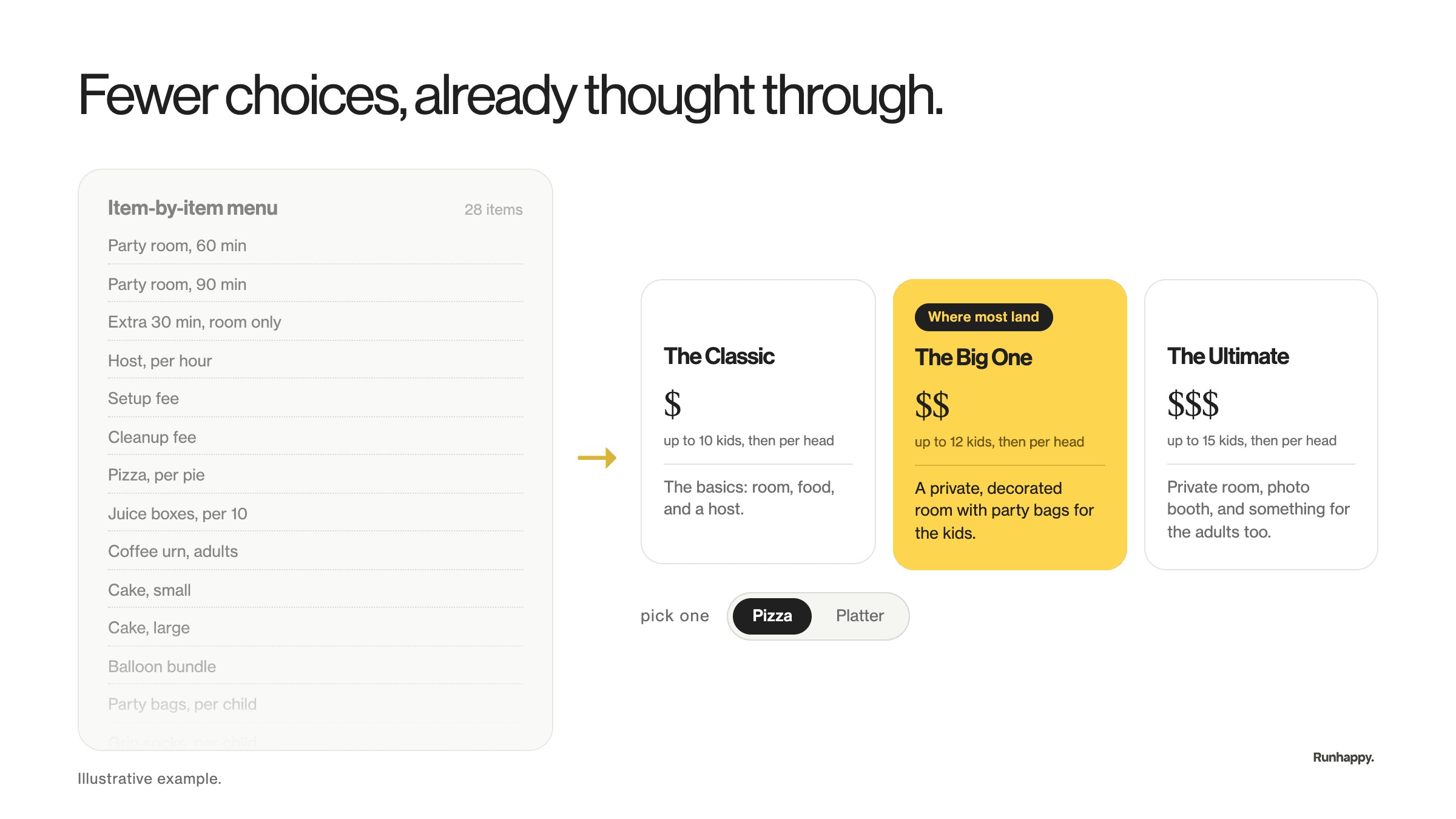
The second is the full à la carte menu. Every extra the venue can provide, listed out and left for the customer to assemble. This looks like generosity, but often comes across as extra work and research intensive. The parent has no way of knowing whether four pizzas is a lot for fourteen children or how any of it fits with the room time they have booked. So the outcomes are often they either freeze, take nothing, or ask a staff member what most people do.
The research here is fairly well known. Iyengar and Lepper's supermarket study in 2000 ran a jam tasting table with either six varieties or twenty-four. The bigger display attracted more browsers. The smaller one produced roughly ten times the purchases. When somebody lacks the expertise to evaluate options, more options makes deciding harder rather than easier. A parent booking one birthday party a year is precisely that person.
Good design does the thinking in advance so the customer has fewer decisions to make and better information for the ones that remain. Two levers do most of that work:
Two birthday package upsell levers
Birthday Package Upsell Lever One: Curated choices, not a blank slate
The fix is fewer decisions, each one already thought through on the customer's behalf.
Offer two or three packages, not five. Each built around a genuinely different kind of day, not the same party at three price points.
A tier that is just the one above it with a few more guests and a longer slot is easy enough to describe, but it gives a parent nothing to weigh up beyond quantity. Faced with a straight more-for-more ladder, people tend to settle on the middle option, which quietly turns your top tier into decoration.
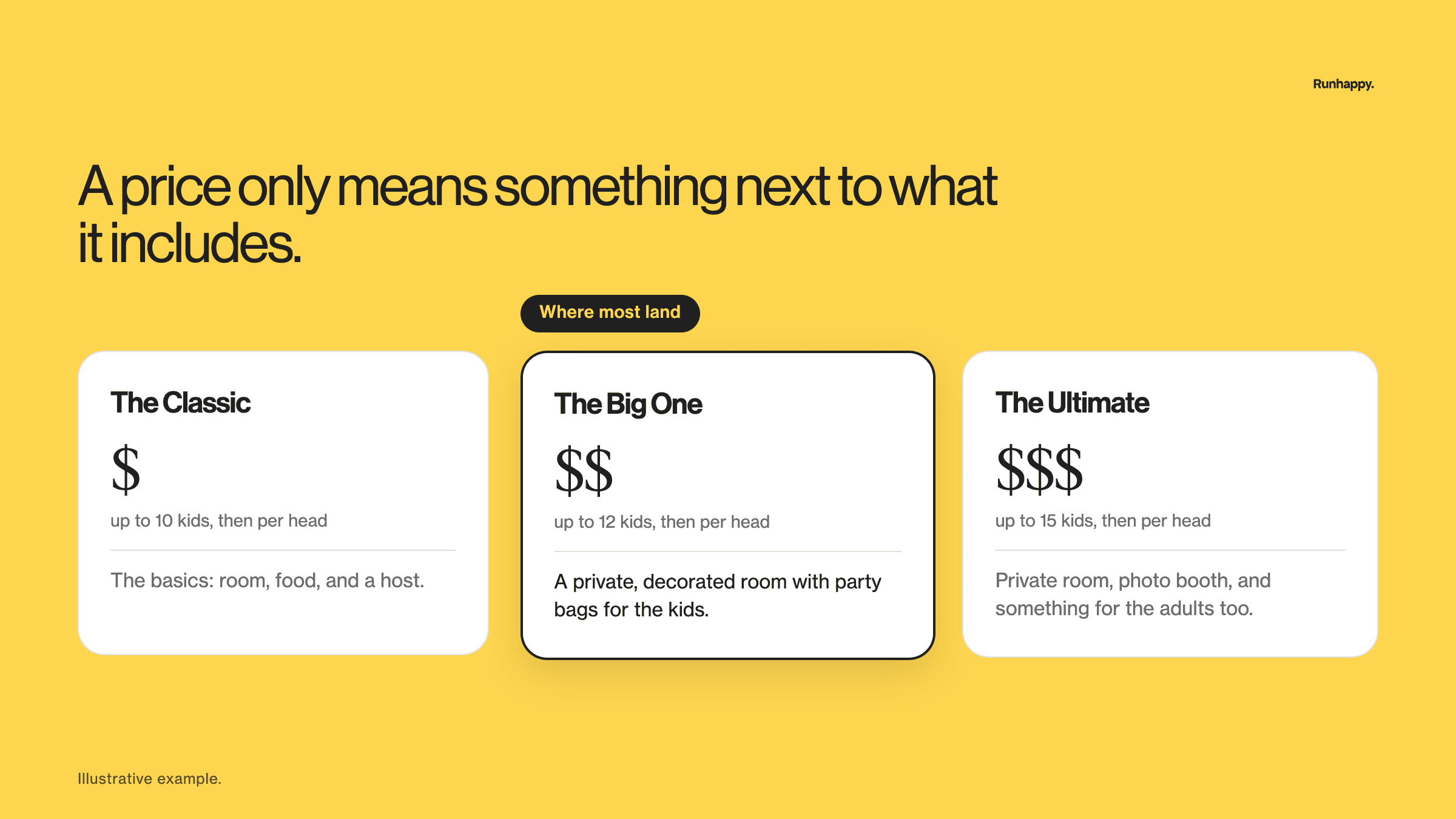
Price for a set number of guests, then charge per head above that. Price for up to ten guests, then a flat rate per additional head.
This is a small change that keeps the conversation on what kind of party someone wants, rather than turning it into a negotiation about numbers.
Give people a choice between two options, not an open menu. Rather than an open menu, offer a decision between two food options, then between two entertainment extras.
The parent still shapes their own party and feels the ownership of having done it. Every combination they can reach is one you have priced, staffed and can deliver on a full Saturday.
Thaler and Sunstein called this choice architecture, and their central point was that there is no neutral arrangement. Some structure is always in place, whether you designed it deliberately or it accumulated over three years of adding things to a list. The only real question is whether you built it on purpose and in whose interest.
That leads to the test worth applying: every option in a set should be one a reasonable parent would be glad they picked.
Birthday Package Upsell Lever Two: Real reference points, not manufactured ones
A price on its own carries no information. Four hundred and fifty dollars is neither expensive nor cheap until there is something beside it, and if you do not supply that comparison the parent will invent one.
Say what each tier covers in one sentence. The room, the food, the host, the setup, the clearing up. Not a features list. A sentence that makes it obvious how much of the day the parent is handing over.
Put that sentence next to the price. The comparison happens at the moment someone reads the number. A value section three scrolls further down is a section nobody reads.
Expect the middle tier to win, and build it accordingly. When priced options sit side-by-side, people tend to settle in the middle rather than at either end. Plan for it. The middle tier is where most of your bookings will land, so it should be the one you are happiest running at volume on a busy Saturday, with the margin and the staffing to match. Venues often put their best thinking into the top tier and their pricing discipline into the bottom one, then discover the middle is carrying the business.
The add-ons worth building into those choices
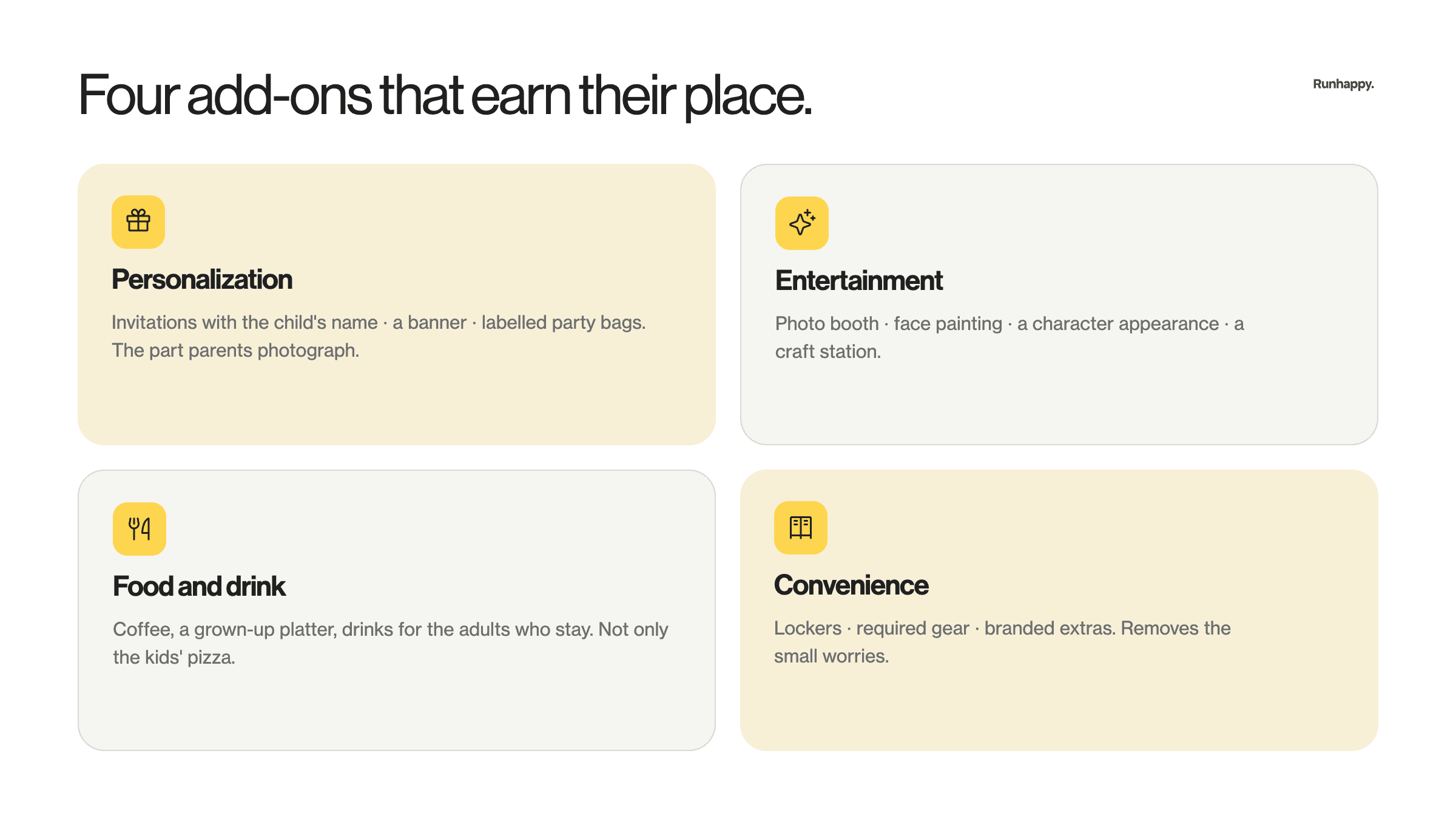
With the structure right, the extras themselves are the straightforward part. Four categories tend to earn their place:
Personalization. Invitations with the child's name, a banner, table settings, party bags labelled per guest. This is the part parents photograph, which makes it the part they remember and mention to other parents.
Entertainment. A photo booth with props, face painting, a character appearance, a craft station that sends everyone home with something.
Food and drink. Reliably one of the strongest levers available, particularly anything aimed at the adults who stay rather than only the children who play.
Convenience. Lockers, required gear, branded extras. Unglamorous, consistently taken, each one removing a small worry from the host's day.
We have watched a venue discover within two weeks that the winning add-ons were adult passes and extra pizza, which told them something the bundle had missed entirely: the parents were not dropping off and leaving, they were staying for the whole thing. The offer got rebuilt around that, and the difference showed up in the average value of every party booked afterward.
What this looks like in practice
Two things have to be true for any of this to work.
The first is that the structure has to live where the booking actually happens, not in a document sitting beside it. Five things belong inside the flow itself:
The tiers, and what visibly separates them
A one-line summary of each, sitting next to its price
The guest-count pricing
The paired choices
The answers your sales team currently gives on the phone
A well-designed package that a parent never encounters is not helping anyone
The second is that someone has to keep watching after launch. An organized, effective booking flow produces something most venues have never had: a clear record of what people actually chose. Which tier. Which add-ons. Where they stopped.
How Runhappy improves your birthday bookings
We build the booking experience itself rather than handing over a tool and wishing you luck. The tiers, the guest-count logic, the paired choices and the add-ons live in the flow. The rules that sit in your sales team's heads get built into it, so ordinary questions stop becoming phone calls and the genuinely complicated ones still reach a person. It connects to the systems you already run, so a booking lands where your team expects it, with what they need to set up the room.
Then we read what the bookings say and bring you the findings. Which tier people take, where they hesitate, which extra is quietly outselling the one you built the bundle around. When the offer has guessed wrong we change it, and you see it in the average value of the next party booked. Nobody on your side has to log into anything or open a report to get that.
Your team knows your venue better than any system will. What they tend not to have is a spare hour each week with the booking data, or the capacity to answer a parent at nine on a Sunday evening. Covering that is how venues grow this side of the business without adding headcount, and the bookings still belong to your team.
The throughline
Good choice design gets people to the party they actually wanted, faster and with less second-guessing. The parent who books the larger package because the difference was legible and the choice was easy has not been talked into anything. They could just see what they were buying.
The extra revenue follows from that, and so does the part that compounds: a parent who got the party they wanted, told the other parents at it, and books with you again next year.
If you are looking at your own packages and suspect the structure is what is holding them back, come and talk to us. We will go through what you have and tell you what we would change.
FAQ
How many birthday party package tiers should a venue offer?
Two or three. Beyond that people slow down and drift toward the cheapest option, because price becomes the only thing that is easy to compare when everything else is hard to tell apart. If two of your tiers need explaining to distinguish, they are one tier.
What is bounded customization and why does it work for party packages?
It means offering a small, curated set of choices rather than an open menu: a decision between two options at a few points in the booking, instead of a long list of extras. The customer still shapes their own party, but every combination they can reach is one you have already priced and can deliver. It removes the mental work of booking, which is the main reason people abandon a booking flow half way through.
Should party packages be priced per person or as a flat rate?
A hybrid suits most venues. A flat rate covering a set number of guests, commonly up to ten, then a clear per-head price above that. It stops every booking becoming a negotiation about headcount and lets someone understand the price at a glance.
What is the difference between good pricing psychology and manipulative sales tactics?
The test is whether the structure helps somebody decide well, or works against them deciding well. Showing what the same party would cost to organise yourself is useful and true. Setting out exactly what each tier includes lets someone compare properly. Both make the decision easier. Manufactured urgency, a decoy tier that exists only to flatter the option above it, or extras that are effectively required but presented as optional all steer people toward a choice that is not in their interest. Researchers call the first kind a nudge and the second a dark pattern. The difference surfaces a year later, in whether that parent books again and whether they recommend you to the other parents who were there.
Which birthday party add-ons actually sell?
Personalisation, entertainment extras, food and drink, and convenience items are the four categories that reliably earn their place. Which specific ones win varies by venue far more than most operators expect, and it is not something you can work out in advance. Launch a small set, watch what people genuinely pick over the first few weeks, and rebuild the offer around the winners rather than around what you assumed would win.
Do advance booking discounts and off-peak pricing actually work?
They work when the benefit is real on both sides. An advance incentive lets a parent secure the date they are anxious about while committing your revenue earlier. Off-peak pricing gives flexible families a better deal and moves demand off your most constrained slots. Neither relies on invented scarcity, which is why they hold up over time rather than training customers to wait for a discount.
Why do parents skip the add-on step entirely?
Usually because something earlier was unclear. If someone does not know how long they have the room, whether they can decorate it, or whether adults count toward the guest total, they default to the smallest booking available. Answering those questions inside the flow tends to lift add-on uptake more reliably than changing the add-ons themselves.
Our Blog.




Stay in the Loop
More bookings. Higher upsells. Fewer missed leads. Subscribe to our newsletter for the strategies and stories behind venues running on autopilot with Runhappy.