The Modern Venue Booking Playbook: 5 things modern venues do differently
Five plays for the full booking journey, the numbers to track, and a scorecard to show you where to start.

Rachel Boyles
Marketing

A guest has found your venue and thinks it could be right for their event. Before they can book, they need to know whether their date is available, what the package includes and how much it will cost. Getting those answers can involve more work than they expected. They might have to find a package PDF, submit a form, wait for a reply and repeat their requirements when someone calls back. While they wait, they may be having the same conversation with other venues.
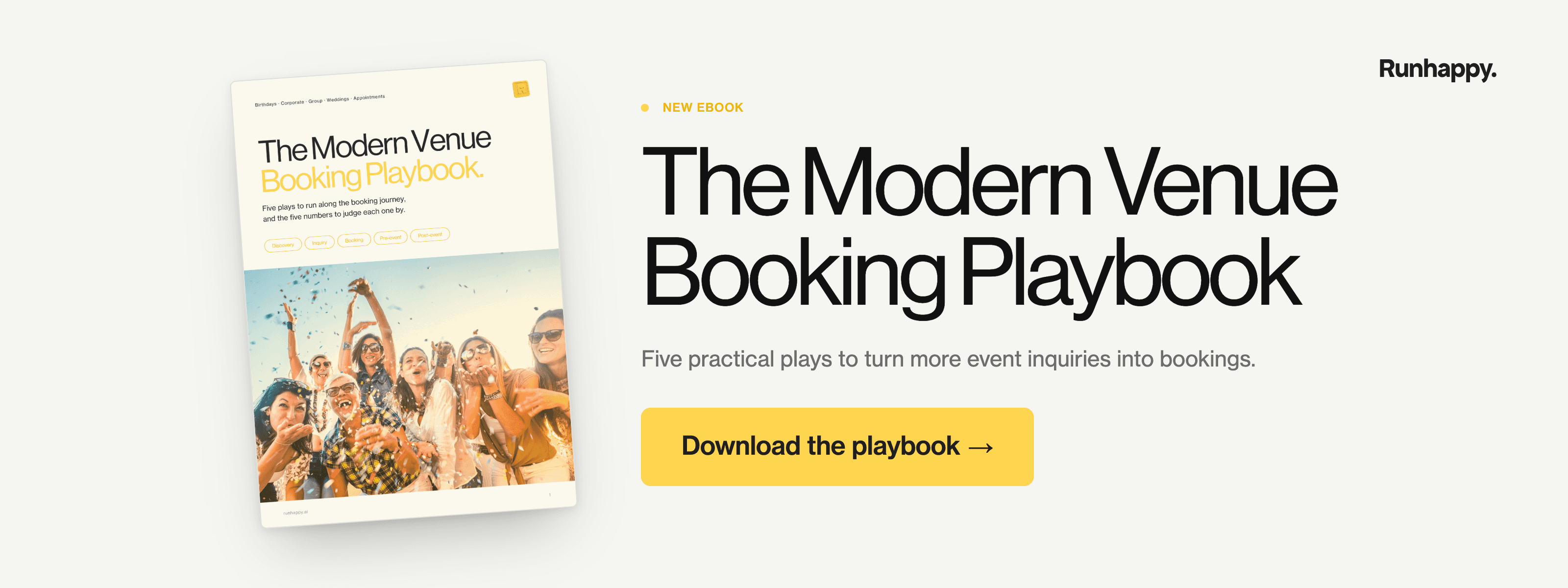
We created The Modern Venue Booking Playbook to help operators look at that experience from beginning to end. It brings together five practical plays, the numbers to track and a scorecard to help you decide where to start.
Download The Modern Venue Booking Playbook.
Start with the guest's experience
Try opening one of your event pages on your phone, as if you were planning a birthday party or a team outing. Can you compare packages and understand what's included? Can you check whether your preferred date is available? Is it clear how to book, pay a deposit or get help with a more complex event?
For example, a parent organizing a party for 12 children needs to know whether a package fits their group and budget. If the page only offers a general inquiry form, they have to wait to find out whether the venue is even an option. A useful booking page helps them make that decision. Standard packages can have a straightforward online booking flow, while events that need a tailored quote should have an equally clear way to get help.
Five plays for the full booking journey
That same attention to the guest's experience matters before they reach your website and after their event has finished. The playbook covers five stages, with practical actions for each:
Make it findable. Help potential hosts discover your event offering through search, ads, listings and recommendations, then reach a page relevant to what they're planning.
Answer while it's hot. Give guests useful answers while they're actively considering their options, including when inquiries arrive after hours. The cost of a slow first reply is bigger than it looks, and we put numbers on it in how many birthday party bookings are you losing to slow reply times.
Make it bookable. Make packages, pricing and availability easy to understand, with booking steps that work well on a phone. How you build and name your packages does a lot of the work here.
Own the lead-up. Keep headcounts, invitations, waivers, event details and outstanding balances organized so the host and your team have less to chase.
Rebook the guests, not just the host. Build relationships with attendees who have opted in to hear from you, and follow up when they're likely to be planning an event of their own.
Each play includes measures to help you assess how it's working, from response time and event-page conversion to bookings from past attendees.
Decide what to improve first
Your team may already handle some of these stages well. The harder question is whether the process works consistently across channels, outside office hours and during your busiest periods. The playbook includes a scorecard that lets you rate each stage from one to four, giving you a total out of 20. Use it with your team to identify where the experience is working and where guests or staff are doing more work than they should.
You might find that inquiries get a quick response while confirming a booking still takes several exchanges, or that the event itself runs smoothly but nobody follows up with guests afterward. Your lowest-scoring area gives you a practical place to begin.
Download The Modern Venue Booking Playbook to explore the five plays and score your own booking process.
FAQ
What is The Modern Venue Booking Playbook? It is a free guide for venue operators covering the full event booking journey, from how a host first finds you to how you win their next booking. It sets out five plays, the measures that show whether each one is working, and a scorecard you can run through with your team. You can download it above.
What are the five stages of the venue booking journey? Make it findable, answer while it's hot, make it bookable, own the lead-up, and rebook the guests rather than only the host. Each stage is a point where a booking can stall. Most venues are strong at some and thin at others, which is exactly what the scorecard is designed to show you.
How do I know if my event booking process is losing bookings? The clearest signal is the gap between an inquiry arriving and a useful reply landing. Look at how many inquiries come in outside office hours, how long your first reply actually takes, and how many hosts stop replying after they ask about price or availability. If a host has to repeat their requirements to a second person, that is another place bookings leak.
What should an event page include so a guest can book? Enough for a host to decide without contacting you first. That means packages with what is included, a real price or a clear range, genuine availability for their date, and an obvious next step, whether that is paying a deposit or asking for help with something bigger. It also has to work properly on a phone, which is where most hosts will open it first.
How fast should a venue reply to an event inquiry? Faster than the other venues that host messaged at the same time. Most party and group inquiries arrive in the evening or at the weekend, so a reply that waits for the next working day is often the losing one.
Should every event be bookable online? No. Standard packages suit a self-service flow, while a buyout or a complex corporate booking usually needs a person. What matters is that both routes are obvious and fast. A host who needs a tailored quote should be able to reach someone easily, rather than landing in a general contact form with no sense of price or availability.
How should a venue measure its booking process? Each play has its own measure. Response time and after-hours coverage for the first reply, event-page conversion for the booking step, outstanding balances and chased details for the lead-up, and bookings traced back to past attendees for rebooking. Most venues already hold this somewhere, and applying the data you already have is usually quicker than collecting anything new.
Where should I start if the whole process needs work? Score each stage from one to four and begin with the lowest. Response time is often the quickest gap to close and the simplest to improve, so it is a reasonable default when your scores are close together. The harder test is whether the process holds up across every channel, outside office hours, and through your busiest booking season.
Our Blog.




Stay in the Loop
More bookings. Higher upsells. Fewer missed leads. Subscribe to our newsletter for the strategies and stories behind venues running on autopilot with Runhappy.