How to book out your holiday parties, starting in August
The venues that fill their December calendars do most of that filling before the leaves turn. Here is how to be one of them.

Alice Rizzi Franssens
Marketing

It is August, and somewhere an office manager is already sketching out the company holiday party. Nobody is running early. The venue that answers first is the one that gets the booking.
The inquiries that fill a December calendar arrive in late summer, before the leaves turn, while the season still feels a long way off. What follows is how to catch your share of them now, instead of competing over what is left in November.
Your December is sold in August
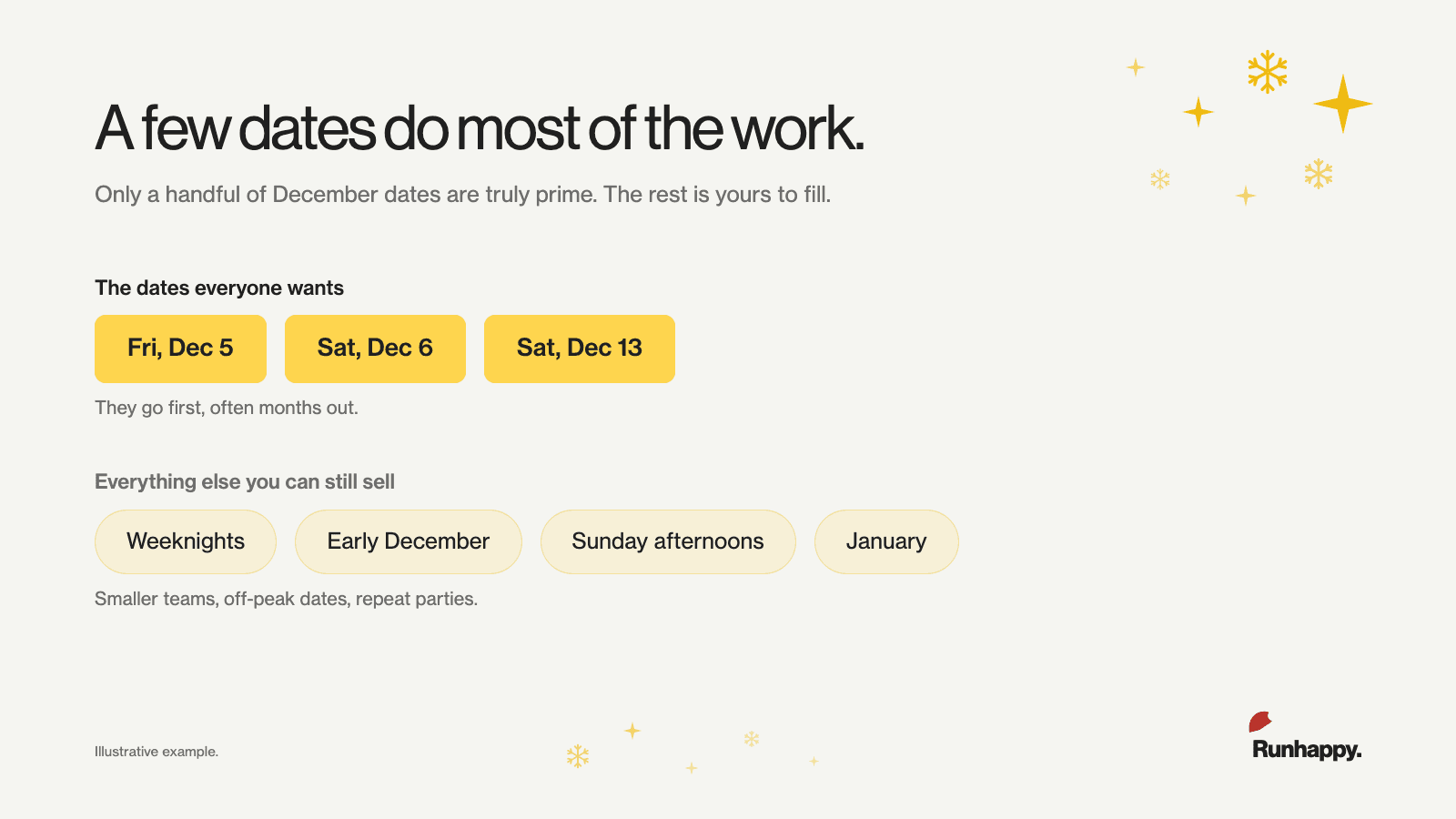
The first two or three Fridays and Saturdays of December are what almost every company asks for, and there are only so many of them. That is not the problem. The problem is when the asking happens.
Corporate parties get sourced in late summer, weeks before the season feels real. Someone is handed the party on top of their real job, given a budget and a rough headcount, and told to find a night the whole team can make. They shortlist, they compare, they hold a date. If you are not visible and answering during those weeks, those bookings still happen. They just happen somewhere else, and your best Saturdays stay open while a competitor's sell out.
They also do not come back. A prime Saturday you failed to sell in August is not rescued in November, because the companies with the budget and the headcount already committed. What is left late is smaller parties and tighter spend.
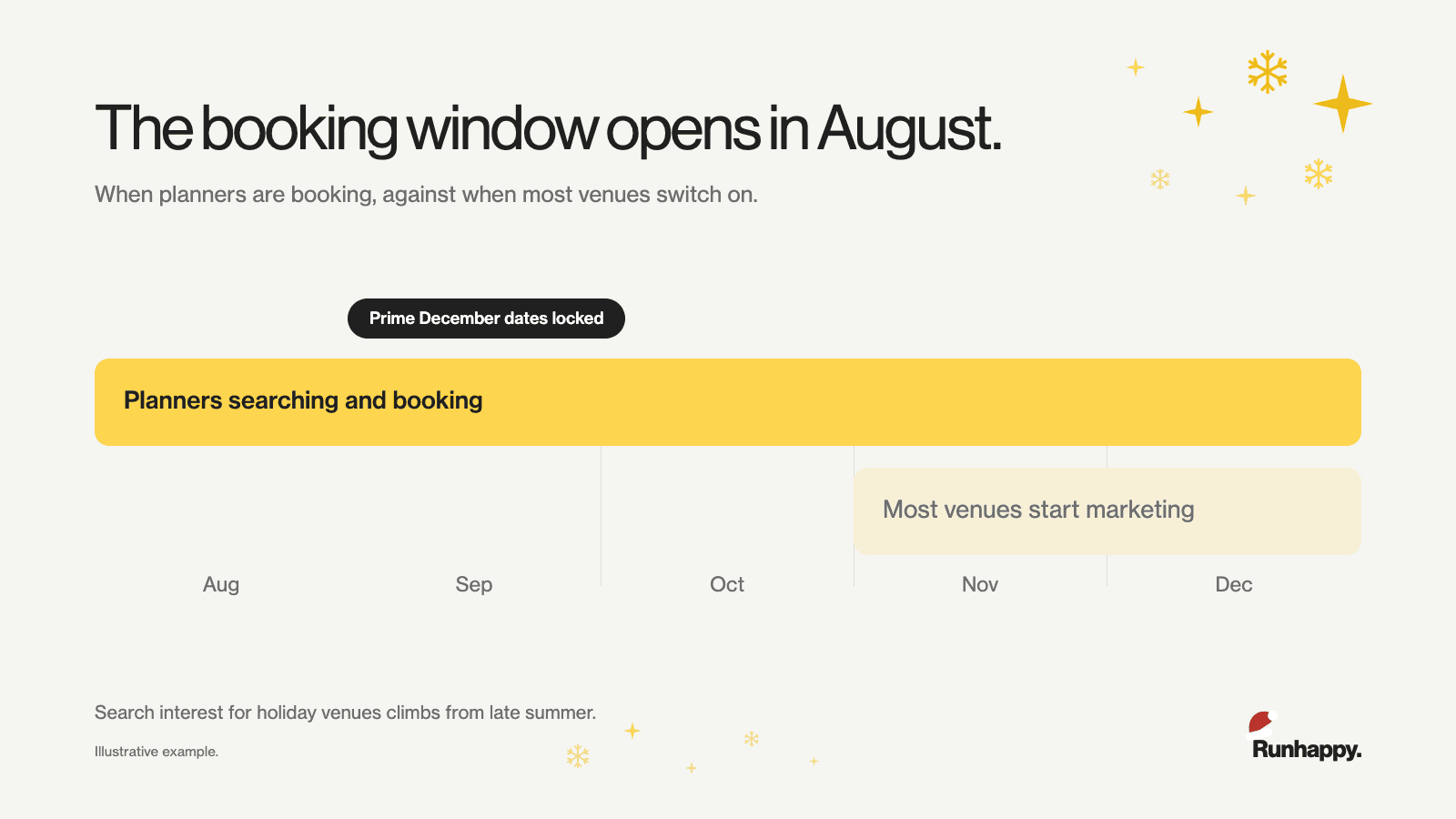
Four ways to fill your holiday season now
Four things separate the venues that fill December early from the ones still selling it in November: being findable early, replying first, working last year's list, and selling the dates around the prime Saturdays.
1 - Be findable before they start looking
The planner's first move is almost always a search, and it happens weeks before they contact anyone. If your holiday offer only appears on your site in November, you have missed the window when the short list gets made.
So put the offer up now. A dedicated holiday page that a search can find, with your December availability, the packages, the capacity, and a fast way to ask a question, does more for your season than any amount of promotion in December. The same rules that make any event page convert apply here, with one addition: it has to exist during the weeks people are actually looking, which is right now.
2 - Answer first, because the first reply usually wins
A planner sourcing a venue is rarely talking to just one. They send the same few questions to a handful of places and go with whoever makes the decision easiest. The venue that comes back first, with real availability and a clear next step, tends to be the one that gets the date. The others are still drafting a reply the next morning, by which point the date is held somewhere else.
This matters more in the holiday rush than at any other time of year, because the volume spikes and so does the share of inquiries that arrive after hours and over the weekend, when no one is at the desk. A message that sits overnight in December is a booking you can watch go cold in real time.
3 - Start with last year's holiday bookers
The warmest holiday lead you have is the company or family that held their party with you last year. They know the room, they liked the night, and they have the same event to plan again. Reaching out in August, before they open a fresh search, turns a booking you would have competed for into one you simply confirm.
Most venues never make that call. The list of last year's holiday clients sits in an inbox or a spreadsheet, and the follow-up that would lock in a repeat before the shopping starts never happens. Getting to those people first, while your competitors are still waiting for the season to feel real, is some of the easiest revenue in the calendar.
4 - Fill more than the prime Saturdays
Only a handful of December dates are truly prime, and once they are gone the instinct is to feel booked out. The venues that win the season keep selling everything around them. Weeknight parties for smaller teams. Early-December and January dates for the companies that deliberately plan around the crush. Lunch and afternoon slots. A clear set of holiday packages that make choosing easy, so a planner can decide in one message instead of five back-and-forth emails about numbers and food.
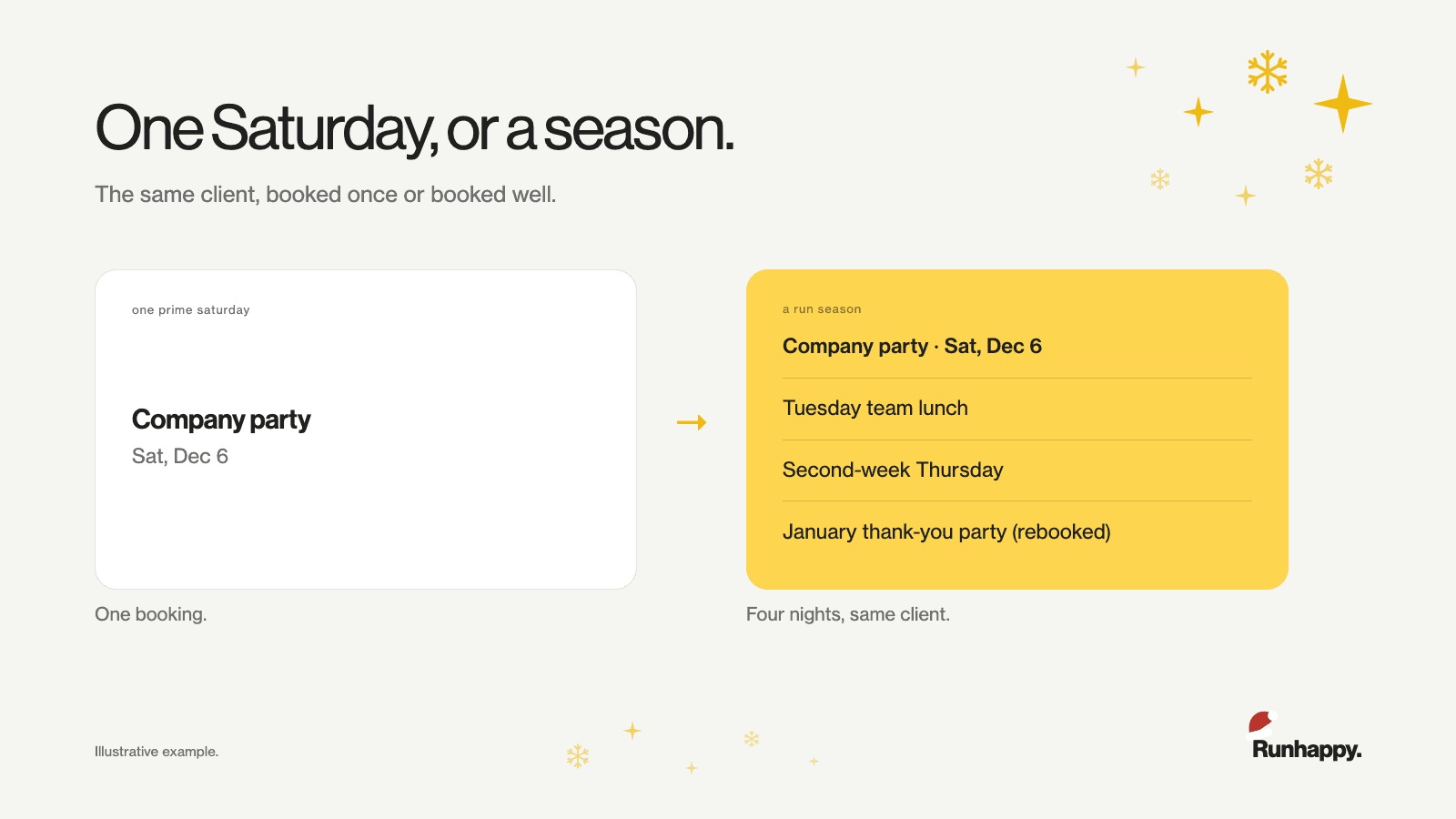
A prime Saturday is one booking. A well-run season is that Saturday plus the Tuesday lunch, the second-week Thursday, and the January thank-you party the same client books because the first one was easy. That is the difference between a good December and a great one, and it comes down to how many of the smaller inquiries you actually catch and convert.
How Runhappy books your holiday season
The hard part of all this is not knowing to do it. It is doing it across hundreds of inquiries while your team is also running the parties themselves. That is the part we take on.
We make sure your holiday pages are live and findable before the searches peak, and we answer every corporate and group inquiry the moment it lands, at 9pm on a Sunday as readily as at 9am on a Tuesday, so you are the first reply rather than the third. We reach back to last year's holiday clients before they start a new search, guide each booking through packages, food, and headcount to confirmed, and manage the calendar so the prime dates are protected and the quieter slots still get filled. It connects to the systems you already run, and nobody on your side logs into anything.
Your team spends the season on the floor, running nights people remember, instead of buried in a holiday inbox.
The throughline
The holiday season is not won in December. It is won in the weeks when it still feels too early to think about it, when the short lists are being made and most venues have not switched on yet. Being findable, being first to reply, and getting to last year's guests before anyone else is how a venue turns a busy few weeks into its best stretch of the year.
If you want to head into fall with your best December dates already filling, talk to our team. The planners are already out there. The only question is which venue answers them.
FAQ
When do companies actually book their holiday parties? Earlier than most venues expect. Serious sourcing for corporate and office holiday parties begins in August and September, and the most sought-after December dates are often committed by early fall. The people organizing these parties are working around a whole team's calendar, so they start well ahead to secure a date that works.
When should a venue start marketing its holiday parties? Now, in late summer. The goal is to have your holiday offer live and findable during the weeks planners are searching and shortlisting, which is well before December. A holiday page that only goes up in November arrives after the decisions that matter have already been made.
How far in advance do the prime December dates fill? The first two or three Fridays and Saturdays of December are the ones everyone wants, and they can be gone months out. Those dates are effectively a small, fixed inventory, so they sell first and fastest. Treat them as the thing to lock early, and plan to fill the rest of the calendar around them.
How do we win a holiday booking when the planner is comparing several venues? Be easy to find, be the first useful reply, and make the decision simple. A planner contacting several venues usually books the one that answers quickly with real availability, a clear package, and an obvious next step. Speed and clarity beat a slower, more detailed response almost every time.
How do we fill the dates that aren't prime Saturdays? Sell the rest deliberately. Weeknights suit smaller teams, early-December and January dates suit companies planning around the rush, and afternoon or lunch slots open up capacity the evenings can't hold. Clear packages and simple off-peak options let a planner say yes to a less obvious date without a negotiation.
Should we contact last year's holiday clients, and when? Yes, and soon. Last year's holiday bookers are your warmest leads of the season. Reaching out in August or early September, before they begin a fresh search, is how you convert a repeat booking you would otherwise have to compete for all over again.
What should a holiday party landing page include? The essentials a planner needs to make a shortlist decision: your December availability, capacity, the packages and what each covers, food and drink options, and a fast, obvious way to ask a question or check a date. The easier you make it to picture and price the night, the more inquiries turn into holds.
Isn't August too early to be thinking about December? It feels that way, and that feeling is exactly why so many venues lose bookings. The short lists are drawn up in late summer and early fall. A venue that waits until the season feels real is competing for whatever dates the earlier-moving venues left behind.
Our Blog.




Stay in the Loop
More bookings. Higher upsells. Fewer missed leads. Subscribe to our newsletter for the strategies and stories behind venues running on autopilot with Runhappy.