Event technology trends: how AI is advancing the booking lifecycle
Faster replies are one part of it. Here is the fuller picture of what AI is doing to booking rate, upsell revenue, and guest lifecycle value.

Alexander Boyles
Marketing

AI’s effect on venue bookings goes beyond how quickly a message gets answered. It also changes how consistently an upsell gets offered, how many stalled inquiries get recovered before they go cold, and how much a venue actually learns about its own guests.
Response speed determines whether an inquiry survives long enough to convert
A managed operation at one FEC location handled 700 group inquiries in a single month, and only 6% of them converted. The reason traced back to a plain inquiry response of "sorry, we’re booked" with no alternative date offered. That same reply pattern, a dead end instead of a redirect, accounted for roughly 600 of the lost leads that month.
The fix is a reply that never closes the door, one that checks real availability and always offers the next open date, the next comparable package, or a waitlist option, converting leads that a flat "no" would have lost entirely.
This is not only a staffing problem, since reply targets still get missed even with larger teams. Adding people helps, but coverage across every hour, every channel, and every reply is a structural problem, not an effort problem.
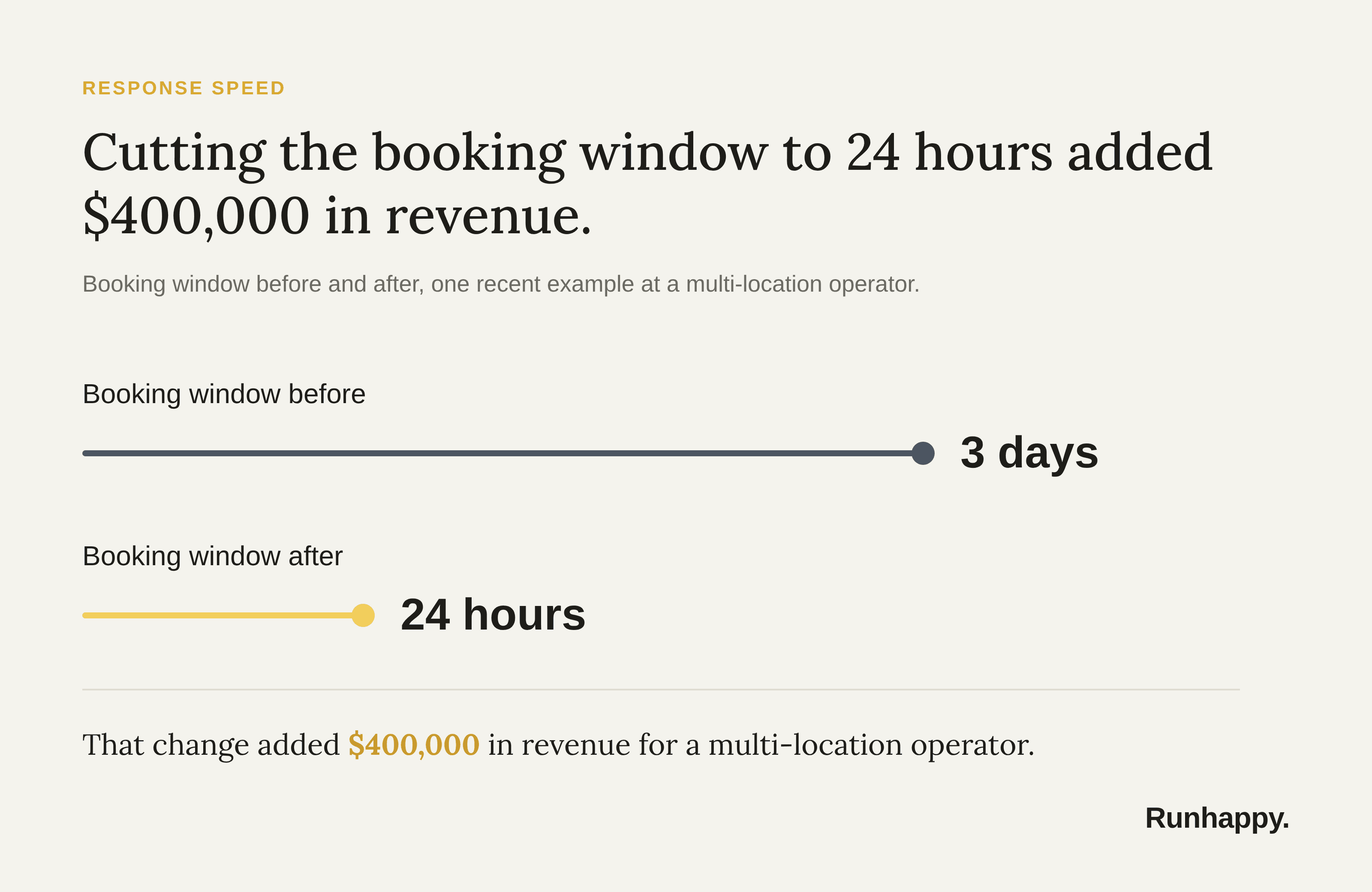
The revenue effect of closing that gap is measurable. Reducing a booking window from three days to 24 hours can add roughly $400,000 in revenue for a multi-location operator, based on one recent example. Coverage, not team effort, was the variable that moved.
A consistent upsell changes average order value more than any single promotion
On average, less than 20% of event sales interactions across experience venues include an upsell. The reason comes down to capacity, since a coordinator handling a full inbox, incoming calls, and an on-site group cannot offer one on every single conversation, even when they know they should.
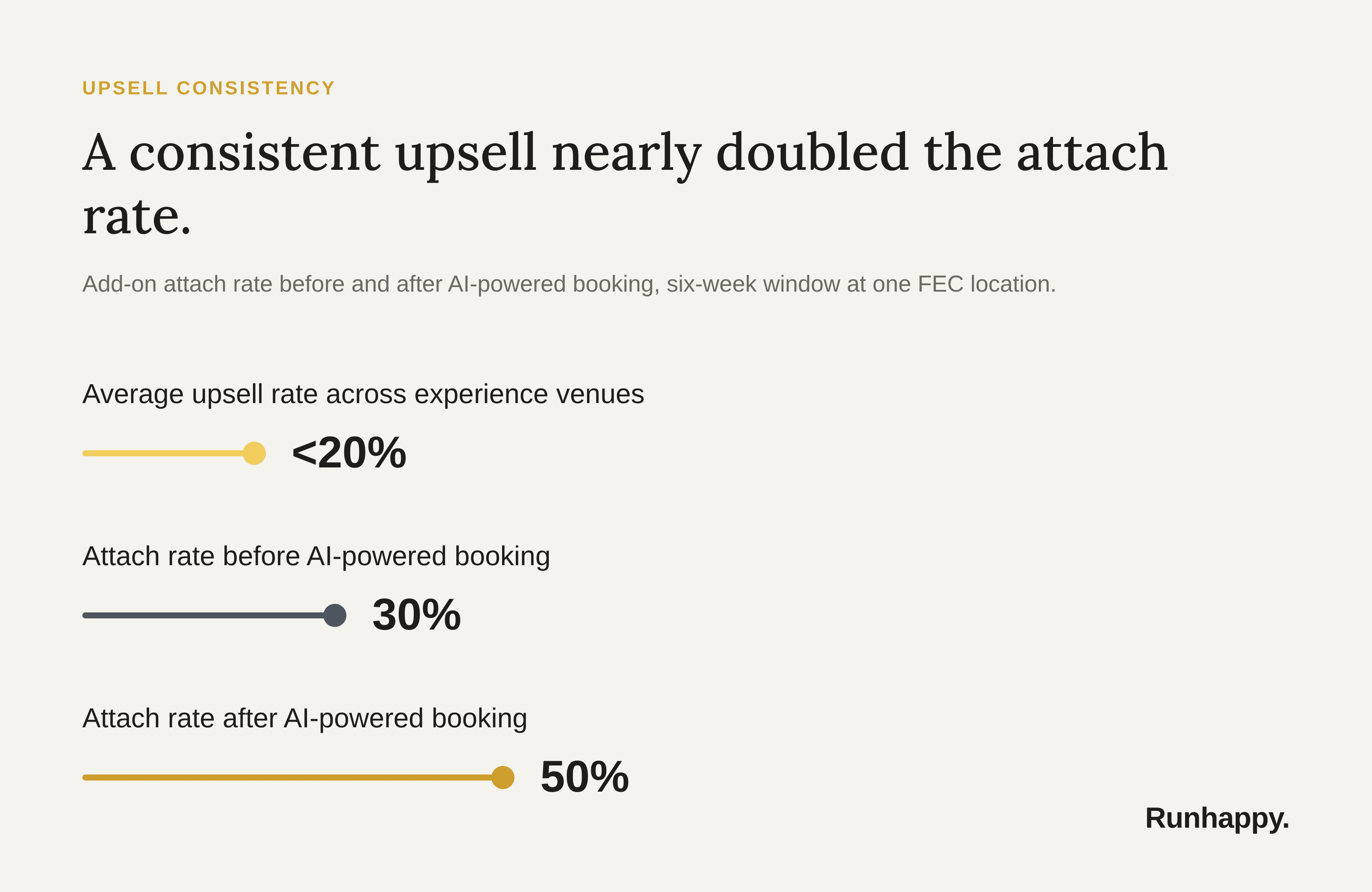
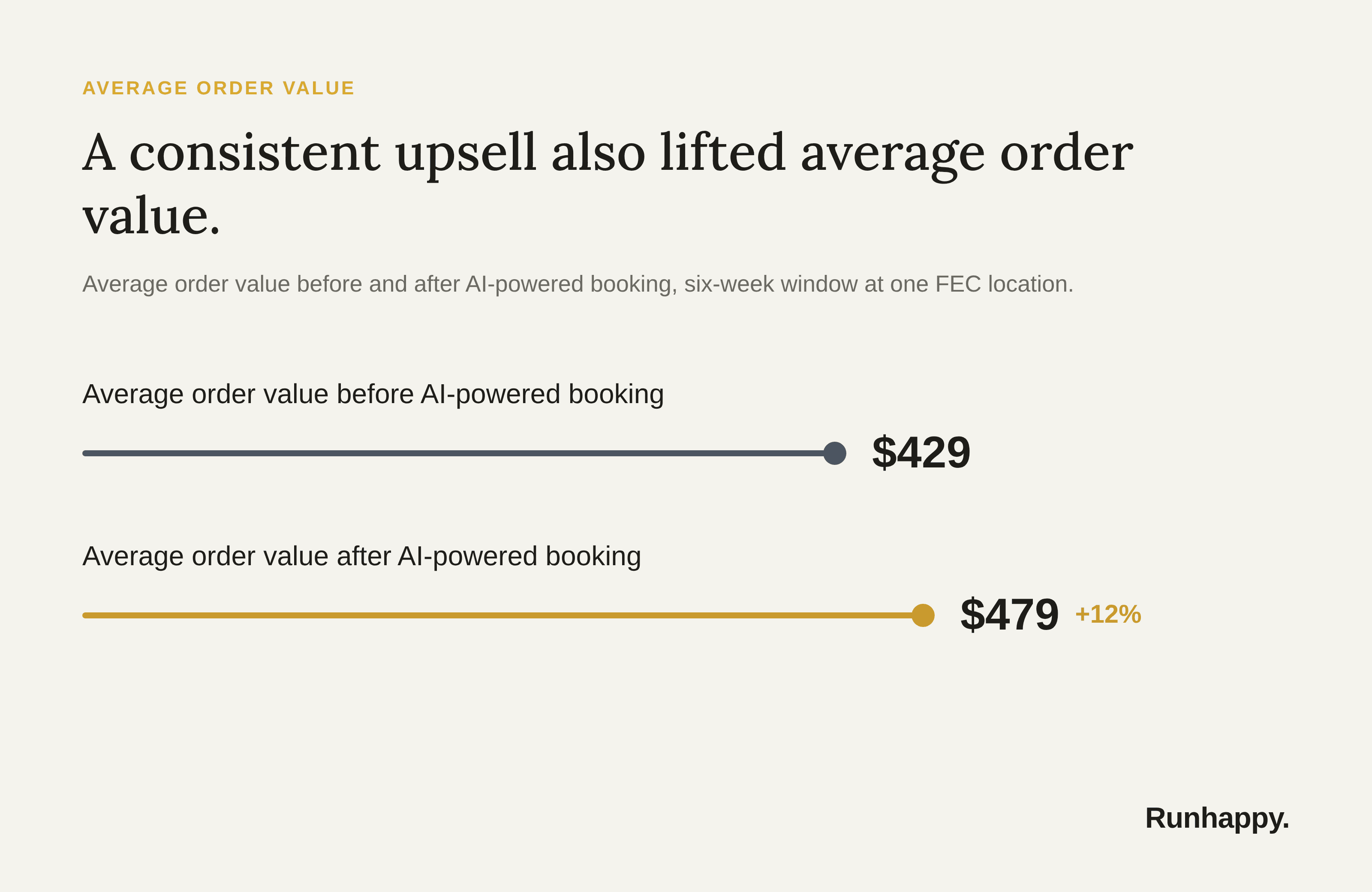
An AI-powered booking operation does not have that constraint. Once it is trained on a venue’s actual packages and pricing, it can offer a relevant upsell on every conversation rather than the ones a coordinator happens to have time for. At one FEC location, add-on attach rate nearly doubled, from 30% to 50%, over a six-week window after upsell offers were built into every booking conversation, and average order value rose from $429 to $479 over the same stretch. Both figures are well above the sub-20% upsell rate typical across the industry.
Recovering the inquiry that already went stalled
Some of the highest-value recovery happens later, when a lead sits unanswered because the one person handling it is out, busy, or simply behind. A booking operation that runs continuously can re-engage a backlog of unanswered inquiries the same way it handles a new one, checking current availability, offering real options, and picking the conversation back up instead of letting it go cold.
This matters most at smaller venues, where a single seller or coordinator often owns most of event sales. If the person handling a venue’s birthday sales is out for an extended stretch, inquiries can pile up unanswered. Re-engaging that backlog with the same process used for a new inquiry can convert bookings from leads that had already gone quiet, roughly $50,000 in one recent case. A backlog is not a lost opportunity if something is still following up on it.
Turning every conversation into guest data
Every party brings roughly 12 to 15 guest households, and most venues only have contact information for the host. Those guests attended, had a good experience, and are warm candidates for a future booking, but without a way to capture them at the moment of the event, that connection ends when they walk out.
An AI-powered booking operation generates a consistent data trail across every conversation, covering what packages guests ask about most, which upsells convert, how response time correlates with booking rate, and who attended an event and might book their own next year. That data compounds, and a venue that can see this pattern every week is working from a different starting point than one relying on memory and a handful of repeat customers.
These four levers move revenue together, not separately
Response speed, upsell consistency, stalled-lead recovery, and guest data are four separate levers, and a booking operation that runs continuously moves all four at once. That combination, not any single one of them, is what shows up in a venue’s booking numbers over a full quarter.
Want to see what your own numbers look like across all four today? Talk to our team and we’ll walk through it with you.
Frequently asked questions
Is this just about faster response times?
No. The same operation also offers a consistent upsell on every conversation, follows up on inquiries that would otherwise go stale, and builds a data trail most venues don’t currently have. All four affect revenue independently.
How does the upsell rate actually improve if the packages are complex?
The system is trained on a venue’s actual event packages, pricing tiers, and availability before it goes live, so the upsell it offers matches what the venue actually sells rather than a generic suggestion.
What happens to an inquiry that doesn’t get a response right away?
It stays in the queue and gets a real follow-up rather than falling off after the first message. The same logic that handles a new inquiry, checking current availability and offering real options, applies to a backlog.
Does this replace a platform like ROLLER or Mindbody?
No. It runs on top of your existing booking and ticketing system. You keep the system that runs your venue; this handles the sales and communication layer in front of it.
What data do I actually get out of this?
Ongoing reporting on inquiry volume, response time, booking rate, upsell performance, and guest lifecycle activity, showing the pattern of what’s converting and where the opportunity is, by location and event type.
Our Blog.


Stay in the Loop
More bookings. Higher upsells. Fewer missed leads. Subscribe to our newsletter for the strategies and stories behind venues running on autopilot with Runhappy.